
My cousin was able to catch her 3 beauties on the stairs. From top, Griffin, LoRyder, and bottom is Circe. What a group! Griffin is an ambassador for Pinup’s for Pitbulls. My cousin Sarah was Miss 2015. Check them out for a great cause.
Happy Wordless Wednesday
H

This is a Wordless Wednesday Blog Hop. Thanks to BlogPaws for the hop. Head over there and see what they are blogging about.
Just another DogDaz morning at the zoo ❤ 
Tags: animals, Best Friends, Blog, blog hop, dog, Dog People, dog rescue, DogBlog, DogDaz, Dogs, lorian lipton, nature, Pet, pet blog, pets, pinups for pitbulls, pit bulls, postaday, Wordless Wednesday

The vet said the anti-scratch cone would be $50.00….Tractor Supply had it for $19.95…..
Source: Bob Lindsey
Just another DogDaz morning at the zoo ❤
Tags: Animal, animal awareness, animals, Dog People, DogBlog, DogDaz, funny dogs, lorian lipton, nature, pet blog, pet humor, postaday

I cannot imagine a life without cats!
Source: The Cat Book
Just another CATDogDaz morning at the zoo ❤
Tags: Animal, animal awareness, animals, Cat, cat naps, Cat People, cat shaming, cats, caturday, DogDaz, lorian lipton, nature, pet blog, pets, postaday

How can one of the most popular chew sticks on the planet be so dangerous for your pets, you ask? I mean, most dogs chew on rawhide for hours on end, and not only does it keep them busy, but they seem to last forever.
Well if you understood what it took to make this toxic “raw” leather stick, you would quickly understand what the problem is.
Aside from the horror stories circulating all over social media these days, of pets needing emergency surgery after consuming rawhide, the majority of pet parents today, especially the newbies, believe that this chew is some sort of dried up meat stick. Let me debunk that myth right away!
A rawhide stick is not the by-product of the beef industry nor is it made of dehydrated meat. Rather, rawhide is the by-product of the “Leather Industry”, so theoretically it is a leather chew. Sounds awesome, right?
“Producing rawhide begins with the splitting of an animal hide, usually from cattle. The top grain is generally tanned and made into leather products, while the inner portion, in its “raw” state, goes to the dogs.” TheBark.com
So, how does this leather, which is conveniently rolled up into pretty shapes, actually get made into those rawhide chews?
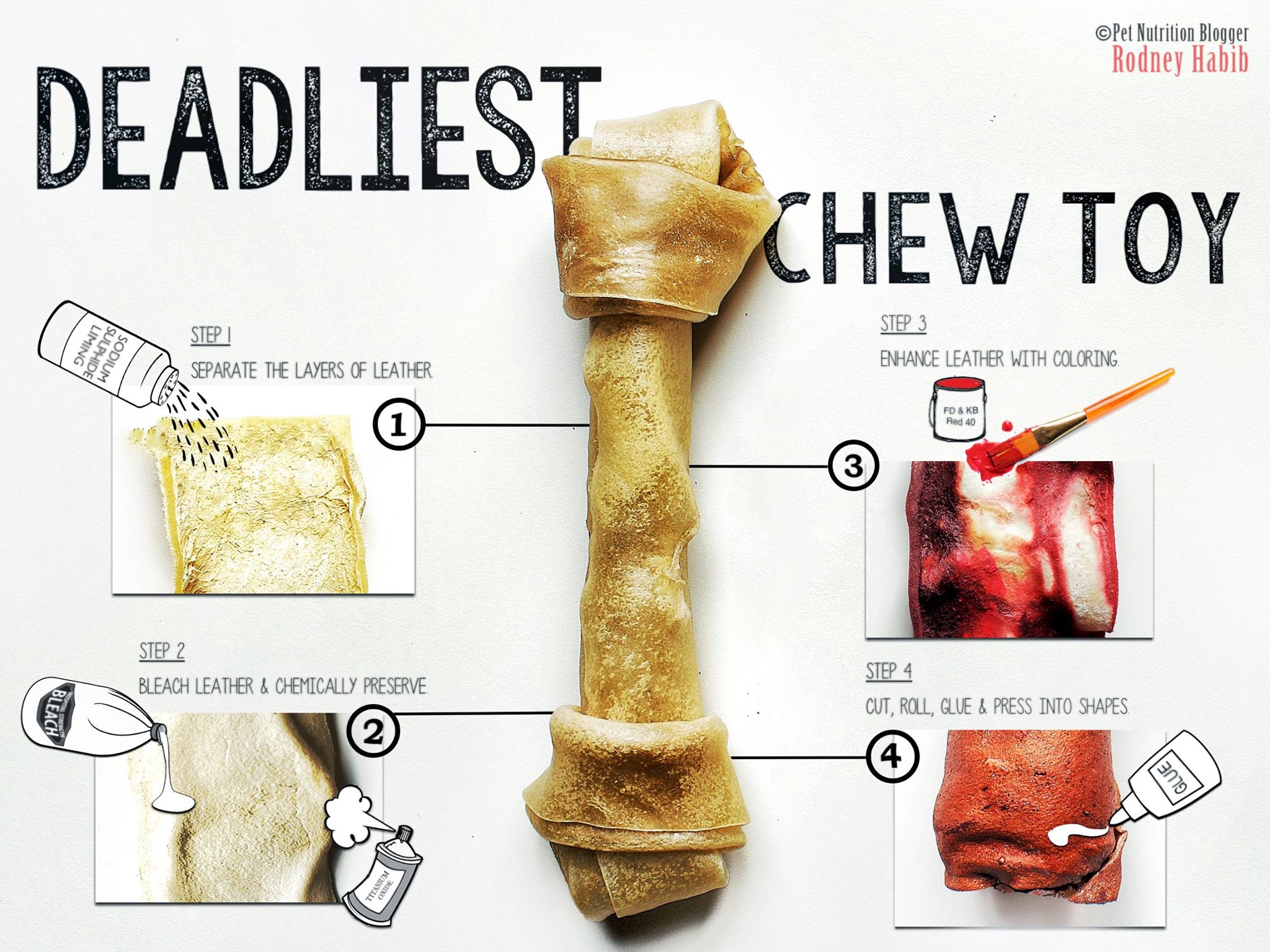
Follow along my friends and I will enlighten you on how this hide travels through a leathery process where it transforms from hide to a not-so beautiful, colorful, chew stick. Here is a paraphrased tutorial that was explained by the whole dog journal several years back:
STEP 1: Normally, cattle hides are shipped from slaughterhouses to tanneries for processing. These hides are then treated with a chemical bath to help “preserve” the product during transport to help prevent spoilage.
(No one wants to purchase a black, spoiled rawhide stick!)
Once at the tannery: the hides are soaked and treated with either an ash-lye solution or a highly toxic recipe of sodium sulphide liming. This process will help strip the hair and fat that maybe attached to the hides themselves.
(No, no one wants to see a hairy hide…)
Next on this glorious journey, these hides are then treated with chemicals that help “puff” the hide, making it easier to split into layers.
The outer layer of the hide is used for goods like car seats, clothing, shoes, purses, etc. But, it’s the inner layer that is needed to make the rawhide. (Oh and other things like gelatin, cosmetics, and glue as well!)
STEP 2: Now that we have the inner layer of the hide, it’s time to go to the post-tannery stage! Hides are washed and whitened using a solution of hydrogen peroxide and/or bleach; this will also help remove the smell of the rotten or putrid leather. Bonus!
(Research also shows that other chemicals maybe used here to help the whitening process if the bleach isn’t strong enough.)
STEP 3: Now it’s time to make these whitened sheets of this “leathery by-product” look delicious! So, here is where the artistic painting process comes in.
“Basted, smoked, and decoratively tinted products might be any color (or odor) underneath the coating of (often artificial) dyes and flavors. They can even be painted with a coating of titanium oxide to make them appear white and pretty on the pet store shelves.” – whole-dog-journal.com
“…the Material Safety Data Sheet reveals a toxic confection containing the carcinogen FD&C Red 40, along with preservatives like sodium benzoate. But tracking the effects of chemical exposure is nearly impossible when it’s a matter of slow, low-dose poisoning.”– thebark.com
Ok, now that these hides have been painted, it’s time for the final process.
STEP 4: Getting it to last forever!
Because the FDA does not consider these chews to be food, really it’s a free for all when it comes to the manufacturers of these leather strips, and the products they may want to add to these chews, to get them to last forever. Any sort of glue can be added here to get these bad boys to never come apart.
When tested: Lead, arsenic, mercury, chromium salts, formaldehyde, and other toxic chemicals have been detected in raw hides. So it’s safe to say that any sort of glues can be used as well!
Finally, it’s time to package and attach all the glorious marketing labels to the product.
Check out the fine print warning that’s attached with some of these rawhides:
“Choking or blockages. If your dog swallows large pieces of rawhide, the rawhide can get stuck in the esophagus or other parts of the digestive tract. Sometimes, abdominal surgery is needed to remove them from the stomach or intestines. If it isn’t resolved, a blockage can lead to death.“
(Oh, how lovely…)
And there it is! It’s now ready to be shipped to store shelves where it can be purchased for our loving animal companions.
How do proactive veterinarians feel about these chews?
Here is world-renowned veterinarian Doctor Karen Becker‘s take on the matter:
“The name ‘rawhide’ is technically incorrect. A more accurate name would be processed-hide, because the skin isn’t raw at all. But the term “rawhide” has stuck.
Rawhide chews start out hard, but as your dog works the chew it becomes softer, and eventually he can unknot the knots on each end and the chew takes on the consistency of a slimy piece of taffy or bubble gum. And by that time your dog cannot stop working it — it becomes almost addictive.
At this point, there’s no longer any dental benefit to the chew because it has turned soft and gooey, and, in fact, it has become a choking and intestinal obstruction hazard.“
P.S. Ready for the jaw dropper?
An investigation by Humane Society International stated in their report, “In a particularly grisly twist, the skins of brutally slaughtered dogs in Thailand are mixed with other bits of skin to produce rawhide chew toys for pet dogs. Manufacturers told investigators that these chew toys are regularly exported to and sold in U.S. stores.” –dogingtonpost.com
“An educated, informed and well-researched community of pet owners can only put more pressure on the pet food industry to be better! When pet owners know better, they will only do better!”
Just another DogDaz morning at the zoo ❤
Tags: Animal, animal awareness, animals, chew toys, Dog People, dog toys, DogBlog, DogDaz, lorian lipton, nature, pet blog, postaday, Rawhide

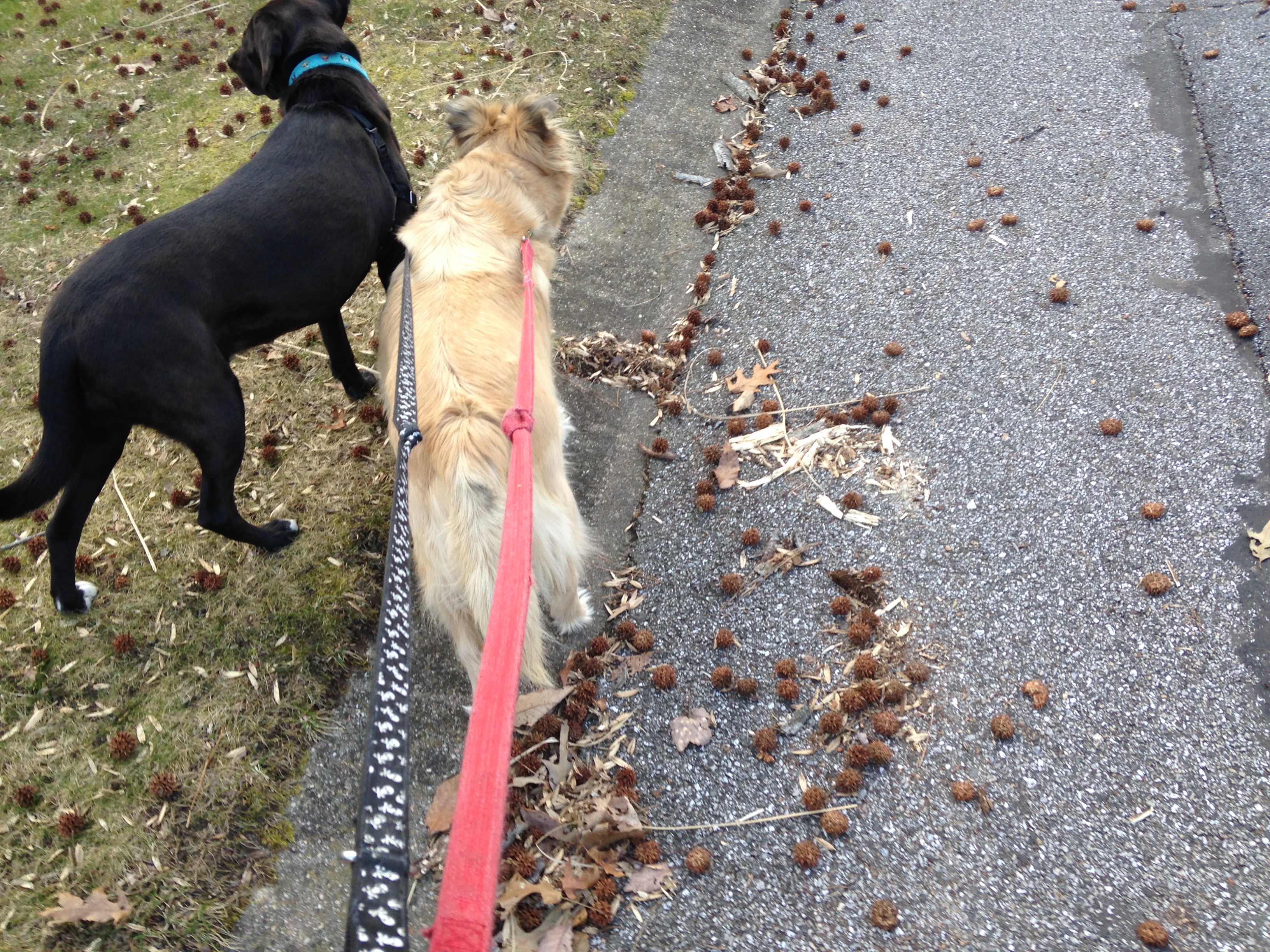
All year long the Sweet Gum trees drop these horrible, spiny, rolly polly, itchy balls. They never seem to stop, but they are worse in the spring and fall. We don’t have any on our property, but everyone else does, so we might as well. They litter the roads, the driveways, and the gardens.
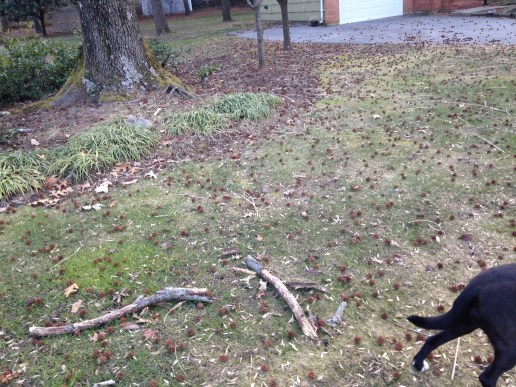
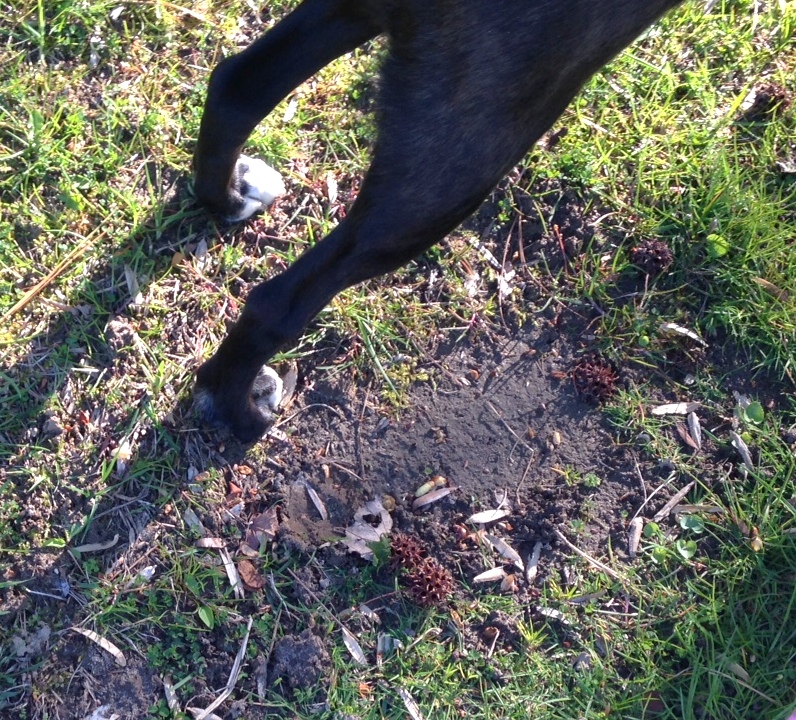
Everywhere, and I mean everywhere you walk or look are these icky brown balls. The dogs jump when they step on them and Mom has fallen flat on the ground by stepping on one.

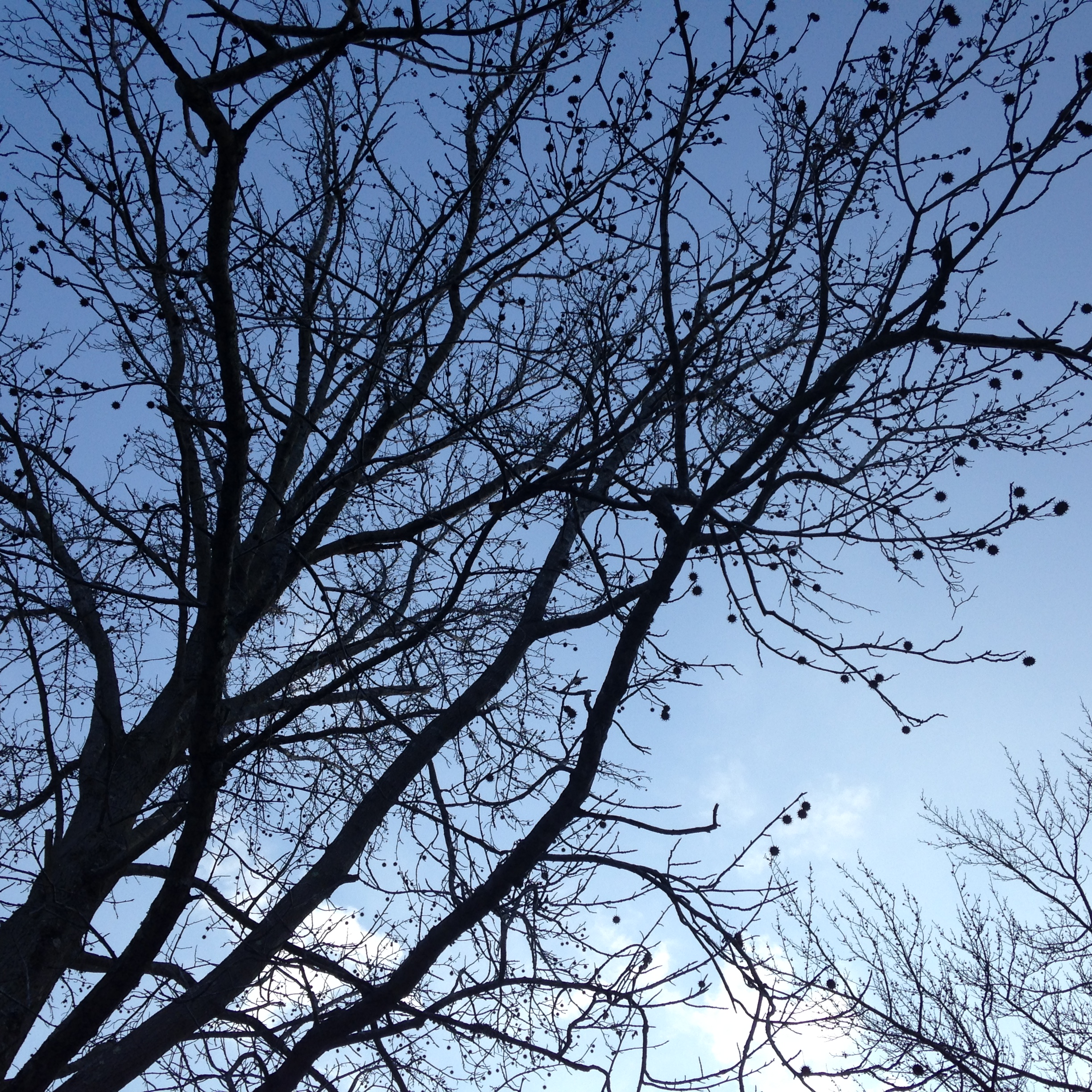
The Sweet Gum is anything but! I really don’t know any human that eats the spiny fruit but I hear that it is sour. And even after the seeds disperse the little brown balls just keep their shape and hang on the tree throughout the winter months.

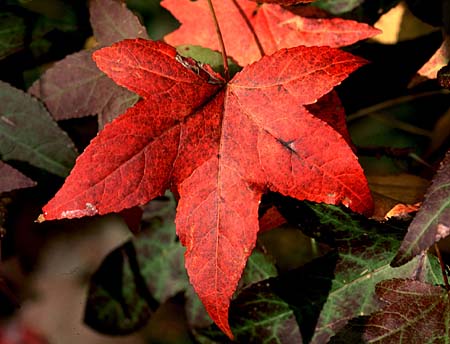
A positive side of this tree is the beautiful color it gives us in the fall and the fact that the goldfinches, purple finches, squirrels, and chipmunks eat the seeds. I understand that it is the most important hardwood in the southeastern United States (where we live), but that doesn’t mean we like them. No, not at all.
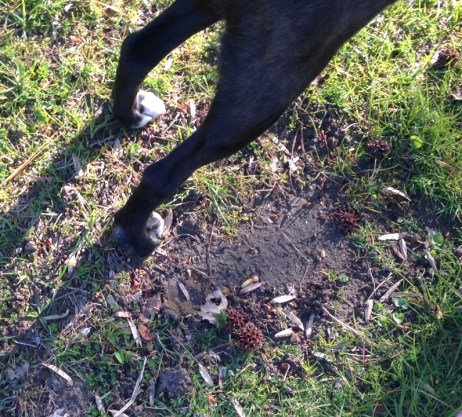
Louise says OUCH!
Do you have a tree or bush you hate where you live? What is it?
Just another DogDaz morning at the zoo ❤
Tags: Animal, animal awareness, animals, Dog People, DogBlog, DogDaz, lorian lipton, nature, pet blog, postaday, southeast trees, sweet gum
Just the other day I posted about how people need to not let their dogs approach other dogs on leash, even if they ‘think’ their dog is friendly. There is a good reason for that! Not every dog is friendly or wants to meet you. So, what do you do when your neighbor won’t put their dog on a leash at all and it runs at you and your reactive dog on leash?
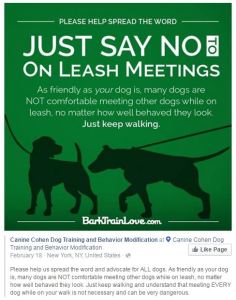
Yesterday my dog walker, Rachel, came in all shaken up after taking Louise for her morning walk. As you know, Lulu is nervous and leash reactive. There is a lady in my neighborhood who never walks her beautiful white golden retriever on leash. This dog, Carmel, runs all over lawns and poops wherever it wants. I have watched this for years (and it has always ticked me off – but that is for another blog). Usually, if I am walking the dogs and I see this dog (or any dog except one we know) coming, I turn around and go another way.
Rachel was having a nice walk with Louise but then bounding out of someone’s yard from behind some bushes comes Carmel. Straight toward Rachel and Louise.
The owner was several yards away paying no attention to her ‘at-large’ animal. Rachel yelled at the dog to stop and placed herself between Louise and this approaching train.
Whether Carmel is friendly or not does not matter. No animal should be allowed to menace my dog walker, my dog, or me. The owner finally called her dog but not after it was right up on Rachel. If Louise had bitten that dog, it would be Louise they take away. Rachel is a wonderful dog walker (Simplifido is her company) and she takes protection of the dogs in her care very seriously. Seriously enough that she put herself between Louise and the approaching dog to protect Lulu. Rachel yelled at the lady to have her dog on leash and that it was the law, but I don’t think the lady cared. Rachel said she did not hear an apology or anything from the woman.
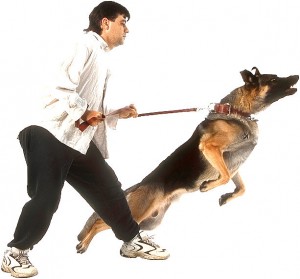
Now here is my question to you, dog lovers and blog friends:
(1) Should I talk to this lady about the situation? I met her once about 15 years ago (she lives about 20 houses away). I see her in the street with the dog often but always keep my distance, for obvious reasons. Not knowing her personally, this would definitely be an uncomfortable situation. Sadly, I doubt she would care or change her behavior even if I talked to her. (But, I was thinking of doing this.)
(2) Do I file a complaint with animal control? The county doesn’t make filing a complaint easy. I would have to send a notarized affidavit of complaint to the county. They will, upon verification and at their discretion, send a notice to the alleged offending owner. This lady could ignore that notice, since county animal control is never around the neighborhood to see. (Rachel thought this might be a good idea if I took pictures of the dog running loose.)
(3) Do I write a letter to the lady myself? This feels kind of like a cowards way out but it would let me express how unsafe letting her dog run loose is. Though it has not happened to her yet, the chance of her dog getting bit, or worse, might scare her into leashing her dog (NOT!). (My sister thought this was the way to go. Safer for me and still expressing my concerns.)
(4) Do I post an open letter in the Community Newsletter? This would be cathartic for me, but I don’t know if anyone, besides me and the people that write it, reads the email from the neighborhood association.
(5) Do I do nothing? Carmel is old (maybe 14 or so) and will probably die in the next year or so (I know that is a terrible way to think). The problem will ultimately solve itself, so why bother. (My spouse’s non-confrontational method.)
(6) Here is Nine’s answer:

I’ve included a link to an informative article on dealing-with-off-leash-dogs. When I read stuff like this at least I don’t feel like I am the only person going through this. I don’t mind turning around to avoid other dogs, but it is so hard when pet owners are clueless of what that action means and just keep walking toward us. And worst, of course, is when they have a loose dog.
Years ago I was a clueless pet owner too. My first few dogs were docile and easy going. Like most people, I had no reason to think about unfriendly, anxious, or aggressive dogs. I had never heard or experienced reactive dog issues. Education is key. We need to help people understand that in a community setting, dogs need to be leashed and kept at a distance unless otherwise discussed.
What would you do?

Just another DogDaz morning at the zoo ❤
Tags: Animal, animal awareness, animals, at large animals, Dog People, DogBlog, DogDaz, leash agression, lorian lipton, nature, pet blog, postaday, reactive dogs
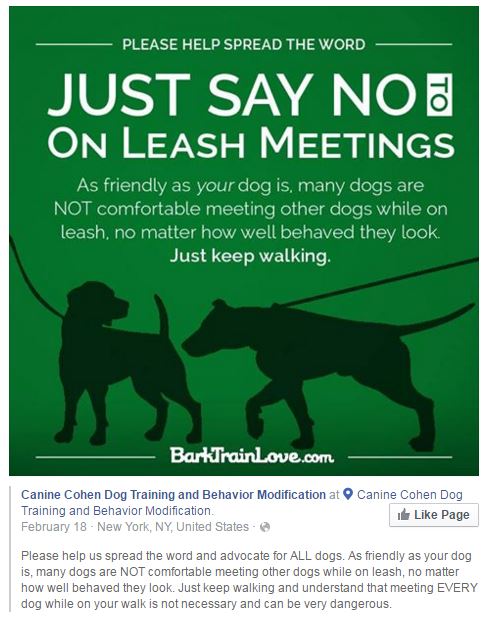
I don’t know this trainer, but I like his message: BarkTrainLove
I wish more people would heed this – it would make my walk with Louise so much easier. And if I turn around and go the other way, it is not because I do not like you, it is because I have a reactive dog. Please do me a favor – don’t catch up to us.
Just another DogDaz morning at the zoo ❤
Tags: Animal, animal awareness, animals, barktrainlove, Dog People, dog training, DogBlog, DogDaz, holistic vet, lorian lipton, nature, pet blog, postaday, reactive dogs, VKH
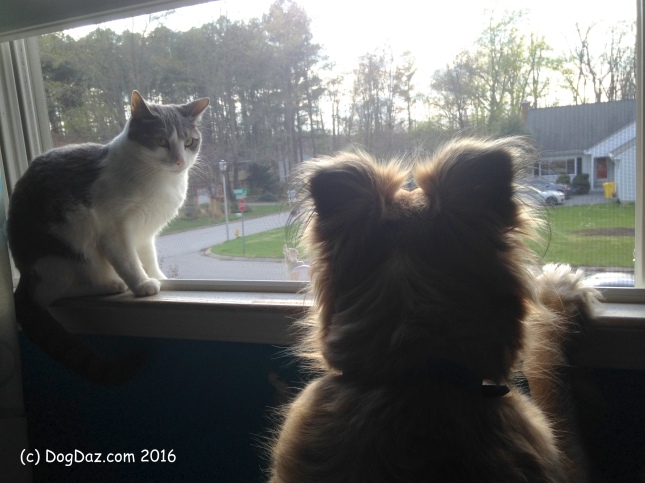
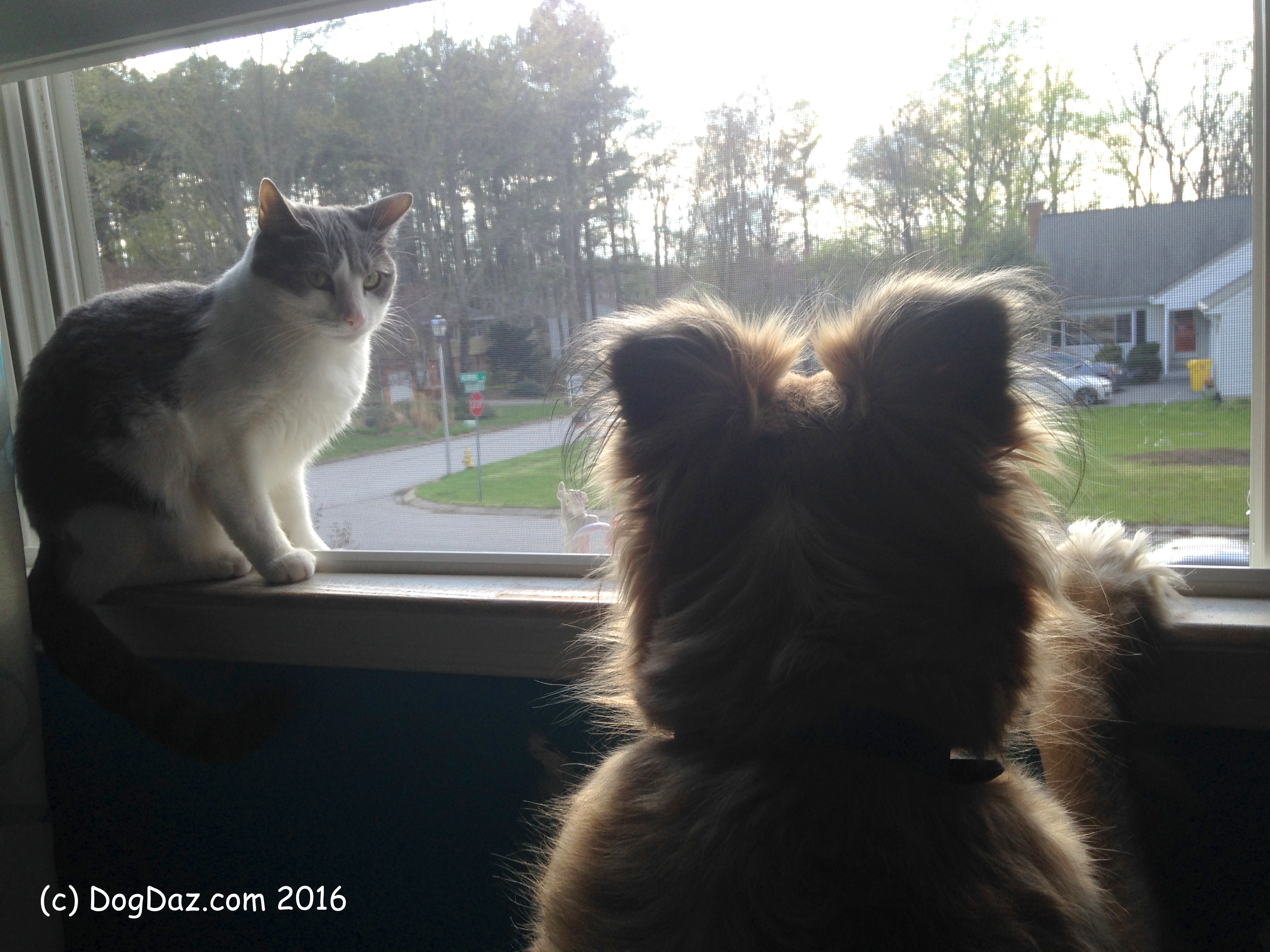
What do you think Nine and Sofie were discussing? I am sure it was something of great importance 🙂
Happy Wordless Wednesday
H
This is a Wordless Wednesday Blog Hop. Thanks to BlogPaws for the hop. Head over there and see what they are blogging about.
Just another DogDaz morning at the zoo ❤
Tags: animals, Best Friends, Blog, blog hop, Cat, cats, dog, Dog People, dog rescue, DogBlog, DogDaz, Dogs, lorian lipton, multi animal household, nature, Pet, pet blog, pets, postaday, Wordless Wednesday

My eye surgery went very well. My challenge now is trying to see with one eye that has the new long distance lense but still has trouble close, and the old eye that still needs glasses for everything and also has a cataract. I thought I would jump right back on the computer, but that work seems the hardest of all to see. The Doctor recommended store-bought readers to help the new eye (can’t use my regular glasses because they are too strong for the new eye). Oh my! If the doctor doesn’t want to fix the other eye soon, I will have to figure out a long term solution. But for now, I am doing my best and feel fine, though I can’t see the way I want to.
While I had surgery, Louise and Sofie went to Sonya’s, the pet sitter. They were there for 3 nights (brought them home a day early because Nine ran away and I was feeling well enough to take care of them). This was the first time since Sofie has been on the Clomicalm and the Melatonin that she has been away for me. She has been sleeping through the night without night terrors for about a month. The first few night’s home she was fine then BAM! – 2 nights in a row the night barking and anxiety behavior returned. Also, while she was gone, Sonya said she had an asthma-like attack. It is allergy season, but the Vet did not want me to give her Benadryl because of all the other stuff. Sonya did say that she thought Sofie was too sleepy and she cut back the Melatonin to 5mg from 7.5mg. Could it have been that? The short separation?
She slept through the night after those 2 events but, my luck, I had to leave on a business trip the following Sunday for 2 nights (so back to Sonya’s for the doggies). Sofie did not have any breathing problems that time. However, 2 days after she got home, she had a night terror. Clearly it wasn’t the smaller dose of Melatonin because I went back to 7.5mg as soon as she came home. Maybe the separation from me or from home? Does she go into a deeper level of sleep at home and that takes her into the terror state?
We went to the vet last week and agreed to 20mg of Zyrtec (a non-drowsy allergy med). She is sleeping and seems her old silly self. She is no longer wheezing or scratching (my other giant fear with an obsessive dog because of the damage she can do to herself). You are a lesson in balance for Mommy, that is for sure, my little Sofie Bear. Now if I can only figure out my eyes.
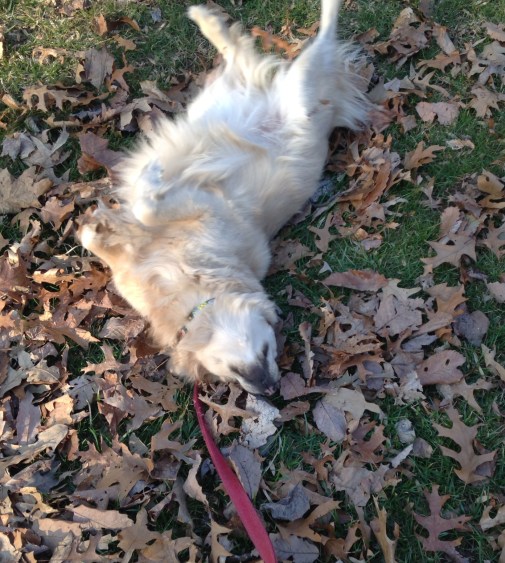
Someone cannot pass a pile of leaves without a good roll. – That’s my girl!
Just another DogDaz morning at the zoo ❤
Tags: Animal, animal awareness, animals, dog, dog medicine, Dog People, DogBlog, DogDaz, Dogs, lorian lipton, nature, pet blog, postaday
5 Facts about Rabbits from Smithsonian: Giant Rabbits
In celebration of the annual spring appearance of the Easter bunny on Sunday, Smithsonian Science offers these facts from Rabbits: The Animal Answer Guide, a new book by John Seidensticker, conservation scientist at the Smithsonian’s National Zoo, and Susan Lumpkin, freelance writer.
 Image: Black-tailed jackrabbit (Photo by Susan E. Adams)
1
Rabbits are not rodents, but lagomorphs (lag–uh-mawrf), a scientific term which means “hare-shaped.” Hares and pikas also are lagomorphs.
2
 Image: A reconstruction of a giant Minorcan rabbit is shown next to a modern European rabbit. (Image by Meike Köhler)
Scientists studying the bones of an extinct giant rabbit found on the Mediterranean island of Minorca estimate this prehistoric animal weighed as much as 31 pounds! The largest rabbits alive today– domestic breeds such as the Flemish giant–weigh 22 pounds at most.
3
Thanks to human introductions the European rabbit (Oryctolagus cuniculus) is found throughout Western Europe, Australia, parts of South America, North Africa and on more than 800 islands around the world. Today in Iberia, Spain, the European rabbit’s sole home for many thousands of years, it is threatened.
4
Archaeologists have evidence of people hunting rabbits in the south of France some 120,000 years ago. Scientists suspect even Neanderthals lived on diets made up largely of rabbits
5
A “never fail” Kansas folk remedy for reducing fever recommends making a strong tea from the dung of the wild jackrabbit and drinking it every half-hour.
(via: Smithsonian Insider)
Wishing sunshine to all who celebrate spring, whatever you call it (Purim, Easter, Earth Day…)
Your friends at DogDaz Zoo.
Tags: animal awareness, animals, DogDaz, Easter Bunny, lorian lipton, nature, pet blog, pets, postaday, Rabbit








 DogDaz Zoo